Section
/What Is the EU e-Evidence Regulation?
e-Evidence Regulation
What is it?E-Evidence refers to digital information that can serve as legal proof in criminal investigations and court proceedings. In the EU context, the e-Evidence Regulation (Regulation (EU) 2023/1543) and the e-Evidence Directive (Directive (EU) 2023/1544) define how law enforcement across Europe can request and obtain such data from Communication Service Providers (CSPs) and digital platforms.
Who is affected?
CSPs, cloud storage providers, social media platforms, and other digital service providers.
What changes?
Requests that once took months under Mutual Legal Assistance Treaties (MLATs) will now require delivery within 10 days—or just 8 hours in emergencies.
Types of data
Subscriber data, traffic data, and content data.
Penalties
Fines of up to 2% of global annual revenue for non-compliance
Section
/Why it Matters
Why it Matters
LIMA e-EvidenceUntil now, cross-border evidence sharing relied heavily on Mutual Legal Assistance Treaties (MLATs), which were often slow and bureaucratic. In urgent cases such as terrorism or cybercrime, delays could mean lost evidence or failed investigations.
New Strict Timelines
The new regulation changes this by introducing strict timelines:
- Production Orders – CSPs must provide evidence within 10 days.
- Urgent cases – Data must be provided within 8 hours.
- Preservation Orders – CSPs must secure data for up to 90 days until a Production Order is issued.
Failure to comply can result in penalties of up to 2% of global annual revenue
Production vs. Preservation Orders
- Production Orders – Legally binding requests requiring CSPs to deliver subscriber, traffic, or content data directly to law enforcement authorities within set deadlines.
- Preservation Orders – Requests obliging CSPs to temporarily prevent deletion of specified data, initially for 60 days and extendable to 90 days.
Both types of orders require fast processing, secure storage, and full documentation. Mishandling even a single order could lead to fines or legal consequences.
Section
/Challenges CSPs Face
The Challenges
CSPs Face
e-Evidence Regulation
CSPs across Europe will need to adapt quickly to comply with the e-Evidence Regulation. Key challenges include:
Accelerated timelines
Meeting 8-hour deadlines for urgent requests.
Round-the-clock readiness
Ensuring 24/7 operational capacity.
Secure system integration
Connecting IT infrastructure to the EU’s new digital communication platform.
Regulatory complexity
Balancing GDPR privacy protections with mandatory data disclosure.
Section
/LIMA e-Evidence
The Complete
e-Evidence Solution
LIMA e-Evidence
LIMA e-Evidence by Group 2000 is built to eliminate complexity and risk for CSPs. It acts as the bridge between service providers and law enforcement, automating every stage of the compliance workflow.
Automation of Orders
1Streamline the intake, validation, and processing of Production and Preservation Orders
Seamless Integration
2LIMA e-Evidence integrates with existing IT systems and workflows, ensuring minimal disruption.
Advanced Tracking & Audit Trails
3Full traceability through integration with the industry-leading LIMA Disclosure System. Every step is logged for internal and external reviews.
Regulatory Alignment
4Fully compliant with ETSI standards and national regulations, helping CSPs avoid costly penalties.
Security by Design
5Encrypted communications, role-based access control, and GDPR-compliant handling of sensitive data.
Scalable & Reliable
6Capable of handling large volumes of requests without compromising performance.
Section
/The e-Evidence Workflow
How it Works
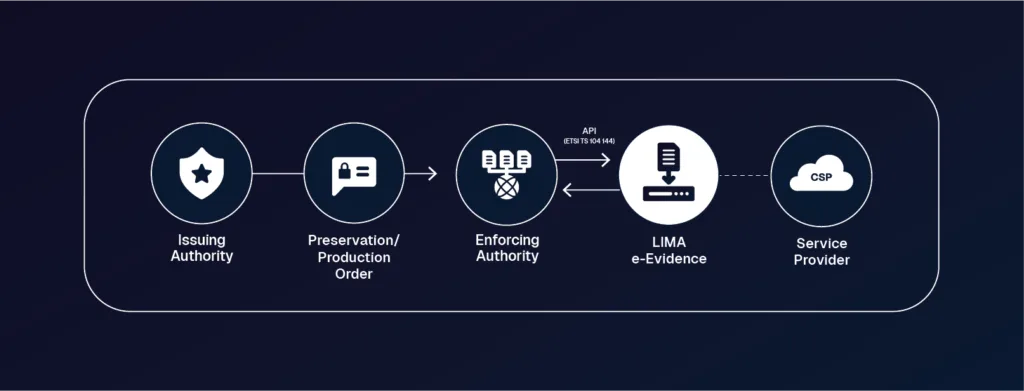
LIMA e-EvidenceThe following workflow illustrates how Group 2000 enables CSPs to efficiently manage and respond to Production and Preservation Orders, ensuring full compliance and accountability throughout the entire process.
Section
/Download the Insight Report
Download the Insight Report
Don't Wait Until 2026The EU e-Evidence Regulation is coming. Ensure your CSP is compliant, efficient, and audit-proof.
Section
/Frequently Asked Questions
Frequently Asked Questions
LIMA e-EvidenceWhich types of data can be requested?
Subscriber, traffic, and content data, depending on the scope of the order.
What is the maximum timeframe for responding?
10 days for standard Production Orders, 8 hours for urgent cases.
How long must data be preserved?
Up to 90 days under a Preservation Order.
What are the penalties for non-compliance?
Fines of up to 2% of global annual revenue, plus reputational damage.
Can LIMA e-Evidence be customized?
Yes, it integrates flexibly with existing CSP workflows and can scale with your needs.
Take Action Today
The countdown to September 2026 has already begun. Are you prepared to handle the demands of the EU e-Evidence Regulation?